Restoration Guide
Mold Remediation Process and Timeline in Sahuarita, AZ
By Water Damage Restoration Sahuarita · 2026-10-25 · Sahuarita, AZ
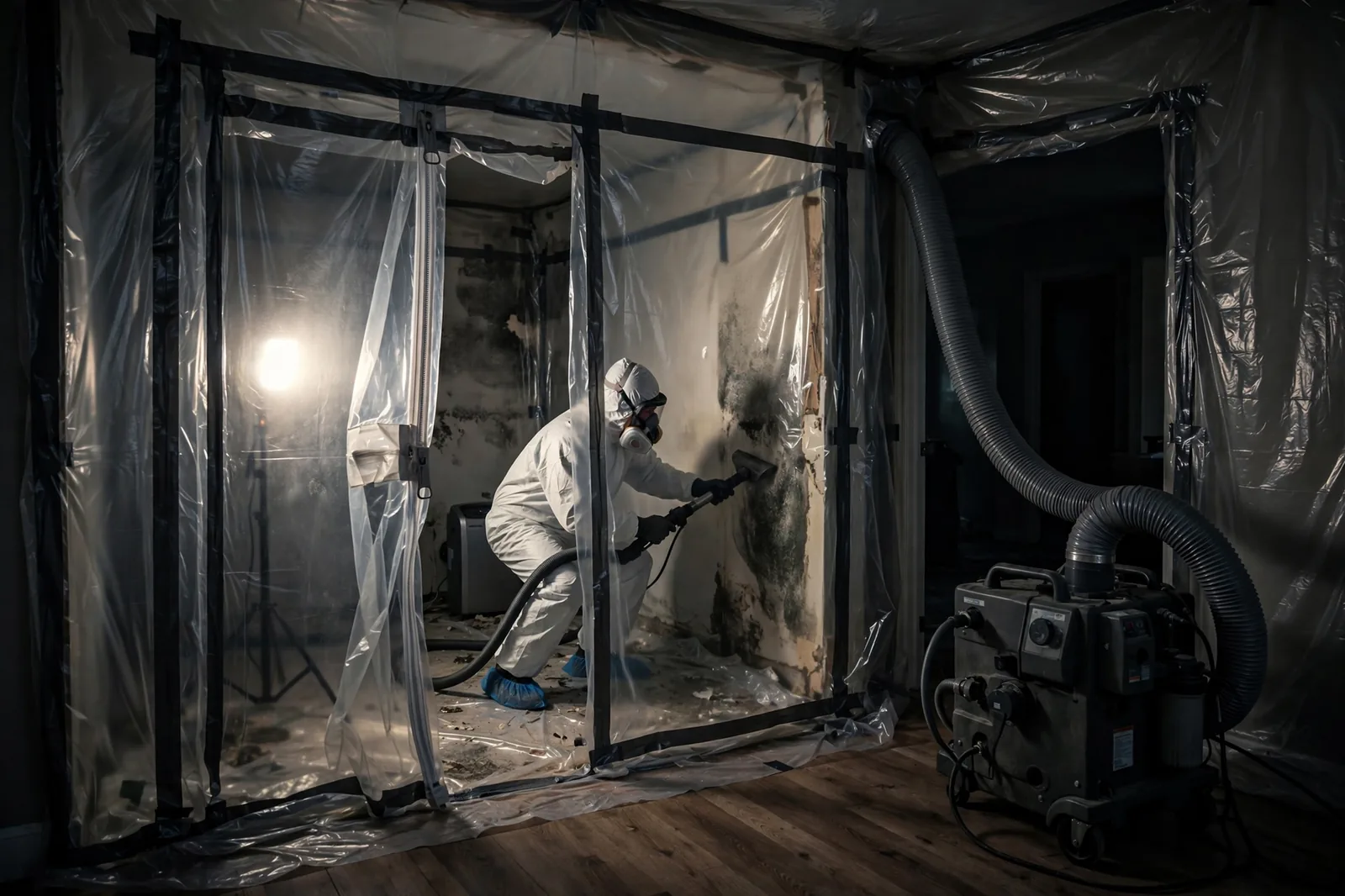
Updated for 2026: this is the complete, no-hype guide to how professional mold remediation actually works, what happens on day one, what the containment plastic is for, how long each phase takes, and how you know the job is truly done. If you have found mold in your Sahuarita home and want to understand the process before you let anyone tear into a wall, start here.
The short version: proper remediation follows the IICRC S520 standard, inspect and document, contain the work area under negative air pressure, physically remove mold from the structure, HEPA-clean everything that remains, verify clearance, and only then rebuild. Anything skipping those steps is a shortcut, not a process. Below is each phase, what it involves, and realistic timelines for Sahuarita homes.
The mold remediation process, phase by phase
Here is the full sequence, in order. Every phase exists for a reason, usually to protect the clean parts of your home from the dirty part being worked on:
- Phase 1, Inspection and assessment. Moisture mapping with meters and infrared cameras, photo documentation, identification of the moisture source, and a written scope. You cannot remediate what you have not found, and you cannot price what you have not scoped.
- Phase 2, Containment and negative air. The work area is sealed with polyethylene sheeting; a negative air machine exhausts filtered air outside, so air flows into the containment, never out. HEPA air scrubbers run inside the space during all work.
- Phase 3, Removal. Moldy porous materials (drywall sections, insulation, carpet pad, ceiling tile) are removed in sealed bags. Remaining structural surfaces are HEPA-vacuumed and damp-wiped or media-blasted. This physical removal, not spraying, is the core of remediation.
- Phase 4, Cleaning and drying. All surfaces in the containment get HEPA vacuuming and cleaning; the structure is dried to verified moisture levels with dehumidification. HVAC components are addressed if the system is affected.
- Phase 5, Clearance verification. Visual inspection, moisture readings, and third-party testing when warranted confirm the space is clean and dry. Only after clearance does reconstruction begin.
- Phase 6, Reconstruction. Removed drywall, insulation, flooring, and finishes are replaced and the space is restored.
What IICRC S520 requires (and why it should matter to you)
The IICRC S520, Standard for Professional Mold Remediation, is the industry's published playbook, maintained by the Institute of Inspection, Cleaning and Restoration Certification. It defines how mold remediation should be performed: assessment, containment under negative pressure, physical removal of contamination, HEPA filtration, and post-remediation verification. It exists so that 'mold remediation' means the same thing no matter which qualified company performs it.
Why should a homeowner care about a standard number? Because it is your quality filter. When you ask a contractor which standard they follow and the answer is a confident 'IICRC S520' with an explanation of their containment and clearance process, you are talking to a professional. When the answer is vague, or the proposal is a single line reading 'mold treatment', you are looking at a shortcut. Insurance adjusters know the standard too, and S520-compliant documentation (photos, moisture readings, itemized scope) is what makes a claim file credible.
How long does mold remediation take? Timelines by scenario
Timeline questions deserve scenario answers, because a closet and an attic are different planets. These are realistic bands for professional work, anyone promising a whole-house remediation in a single day is not following the process above:
- Small contained area (bathroom, closet, under-sink cabinet): often a few days, containment, removal, HEPA cleaning, drying, and clearance verification.
- Single attic section: typically several days to a week, access and heat slow the work, and sheathing areas can be large.
- Multi-room or whole-wall-cavity spread: one to two weeks, demolition, removal, and drying across larger areas, plus coordination of clearance testing.
- HVAC-involved remediation: adds days, system cleaning, coil and drain-pan work, and sometimes component replacement, all under containment.
- Plus reconstruction: drywall, insulation, flooring, and paint add a week or more depending on scope, this phase starts only after clearance.
Where mold hides in Sahuarita homes
Desert homes grow mold in different places than the basement-centric houses of wetter climates. In Sahuarita, our inspections cluster around five zones, and knowing them helps you catch growth early, when the scope is smallest.
Attics lead the list. Monsoon microbursts drive rain under flashing or through aging roof penetrations; the wetted sheathing then bakes under 140°F-plus summer heat, and heat plus moisture is a growth accelerator. Because nobody visits the attic, a leak can feed mold for an entire season. Crawlspaces and low voids under additions come next, poor ventilation, plumbing leaks, and condensation collect there unnoticed.
Behind drywall is where slow plumbing leaks and ice-maker line failures hide; by the time mold shows on the visible surface, the cavity is often fully colonized. HVAC systems, air handlers, coils, drain pans, combine dust with constant condensation, and once mold is in the system it distributes through every room. Under sinks and behind refrigerators and dishwashers round out the list: small supply-line leaks in dark, warm cabinets.
Removal vs. “treatment”: the distinction that protects you
This is the single most important thing to understand before you hire anyone. Mold remediation, properly defined, means physically removing mold contamination from the structure, cutting out affected porous materials, HEPA-vacuuming and cleaning what remains, all inside containment. Antimicrobial sprays, fogging, and 'mold bombs' can be legitimate supporting steps after removal, but they are not remediation on their own.
Why does this matter? Because mold roots into porous materials. A surface spray kills what it touches on the surface and leaves the colony inside the drywall or wood untouched, and the dead surface growth still contains allergens. Weeks later, with moisture still present, it grows back, and the homeowner has paid for the illusion of a fix.
Watch for proposals that lead with the treatment and minimize the removal: 'we'll fog the attic' with no mention of containment, no moisture readings, no clearance verification. A professional scope leads with assessment and removal, mentions the standard it follows, and ends with verification. The order of operations tells you everything.
What happens after clearance (keeping mold from returning)
Clearance is not the finish line, it is the handoff. Mold returns when moisture returns, so the post-remediation conversation should always cover the moisture source: the roof penetration that leaked, the supply line that dripped, the bathroom fan venting into the attic instead of outside, the grading sloping toward the foundation. Fix the water, or you will remediate the same spot twice.
In Sahuarita specifically, the prevention checklist is seasonal. Before monsoon season (mid-June through September), have the roof checked, flashing, penetrations, and any prior repair areas. Keep attic ventilation clear and make sure bath and kitchen exhausts vent outdoors, not into the attic. After any water event, a leak, an overflow, storm intrusion, dry the area within 24 to 48 hours; in our heat, that is the window before mold colonization begins. And if you ever smell that musty odor again, call early. Small mold is cheap mold; the expensive kind is the kind that got a head start.
Frequently Asked Questions
How long does mold remediation take?
Is IICRC S520 a real standard?
Can a monsoon roof leak cause attic mold?
Is fogging alone enough for mold remediation?
Will the mold come back after remediation?
Fire or smoke damage in Sahuarita?
Talk to a local restoration crew today, 24/7 emergency line.
24/7 emergency line, we answer around the clock.